November 2, 2026
Rantec Guar Market Report
This report focuses on the guar harvest, guar gum processing, and commodity trading. Freight market conditions remain largely unchanged, as does the current 10% U.S. tariff.
Rantec Guar Market Report
The guar market remains bullish, supported by strong demand and expectations of a smaller harvest than in previous years. These conditions give farmers greater bargaining power this season.
In early October, we reported that reduced planted acreage and drought-like conditions were expected to significantly reduce this year’s crop compared with last year. Our initial harvest estimate was 7–8 million bags of guar seed, with each bag weighing 100 kilograms. We are now hearing estimates from other sources that the harvest could be as low as 5.5 million bags. For perspective, last year’s crop was estimated at 9–11 million bags, while annual worldwide demand is estimated at approximately 10 million bags.
Based on these estimates, this year’s crop will fall short of demand. However, carryover stocks from previous years are believed to be sufficient to cover the shortfall. Although these inventories are difficult to quantify, market estimates suggest that 6–9 million bags remain available and could enter the market if prices attract sellers.
New seed continues to arrive at a steady pace of approximately 30,000–35,000 bags per day, below the pace reported at this time last year. New seed arrivals generally peak in December.
As discussed in previous reports, guar seed consists of approximately two-thirds germ and hull and one-third endosperm, commonly referred to as the “split.” The split contains galactomannan, the polymer that gives guar gum its thickening properties. Processors separate the germ and hull for use in animal feed, while the splits are further processed into guar gum powder.
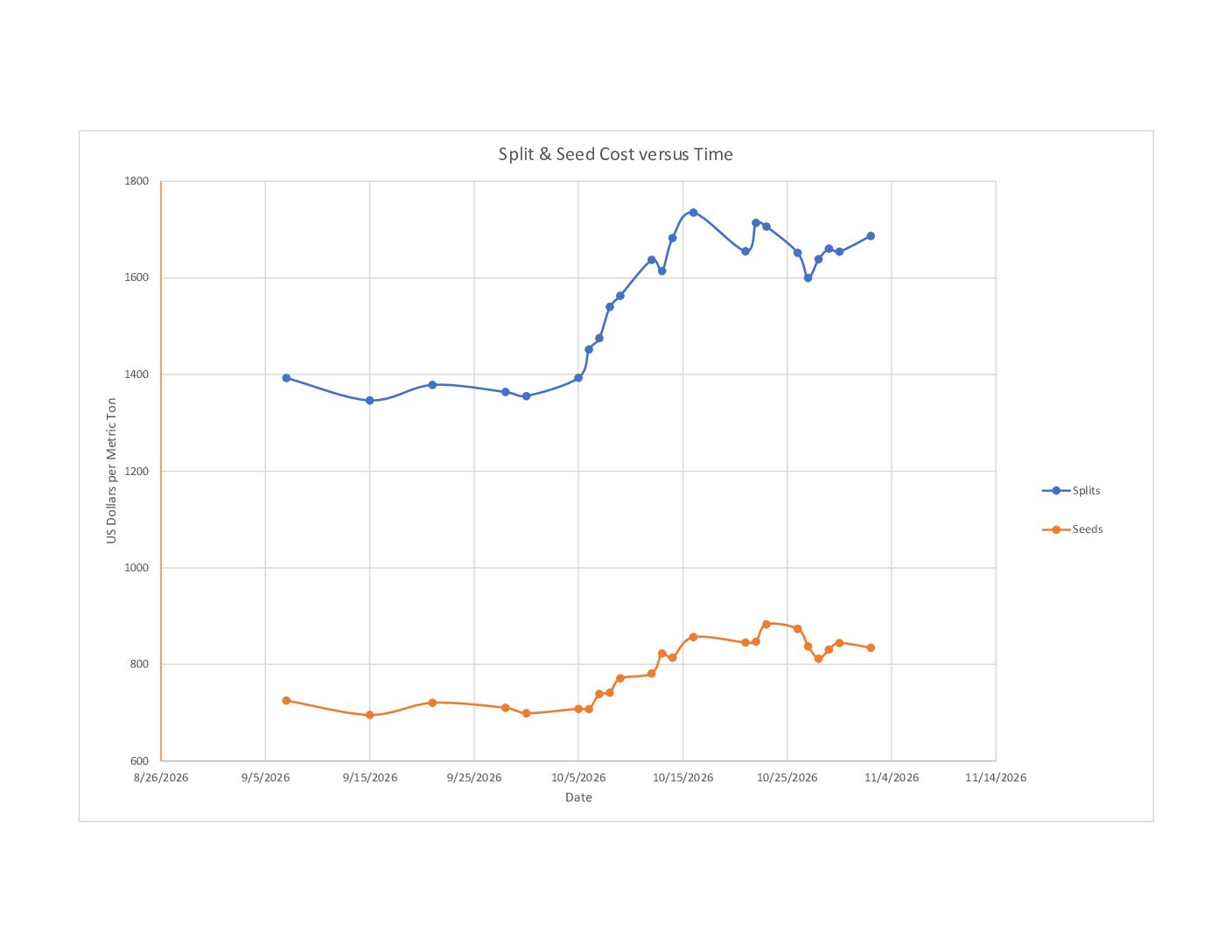
Guar seed and guar gum splits are both traded on India’s NCDEX commodity exchange. Current exchange prices are approximately $834 per metric ton for seed and $1,686 per metric ton for splits. The attached graph shows exchange prices over the past few weeks and illustrates the recent upward trend.
Seed and split prices generally move together, although they can diverge over shorter periods. Today, split prices are rising faster than seed prices. Market sources attribute this to split processors idling their plants because of negative processing margins, tightening the near-term supply of splits. Processors are expected to resume production when the relationship between seed costs and split selling prices allows margins to turn positive.
Demand remains strong across the food, industrial, and oil and gas sectors, with continued strong consumption expected in 2027.
Please let us know if you have any questions or would like to discuss current market conditions in more detail.
Rick Bilodeau